The First Hurdle: Atlanta International, Summer 2023
I remember the first time I really felt the weight of airport accessibility. It was July 2023 , a humid Atlanta afternoon, and I was preparing for a week-long trip to Florida's Gulf Coast. My manual wheelchair , packed with a lightweight foldable TravelChair Pro , was ready, my carry-on strapped to the back, and my service dog, Roux , wagging nervously at the security line.
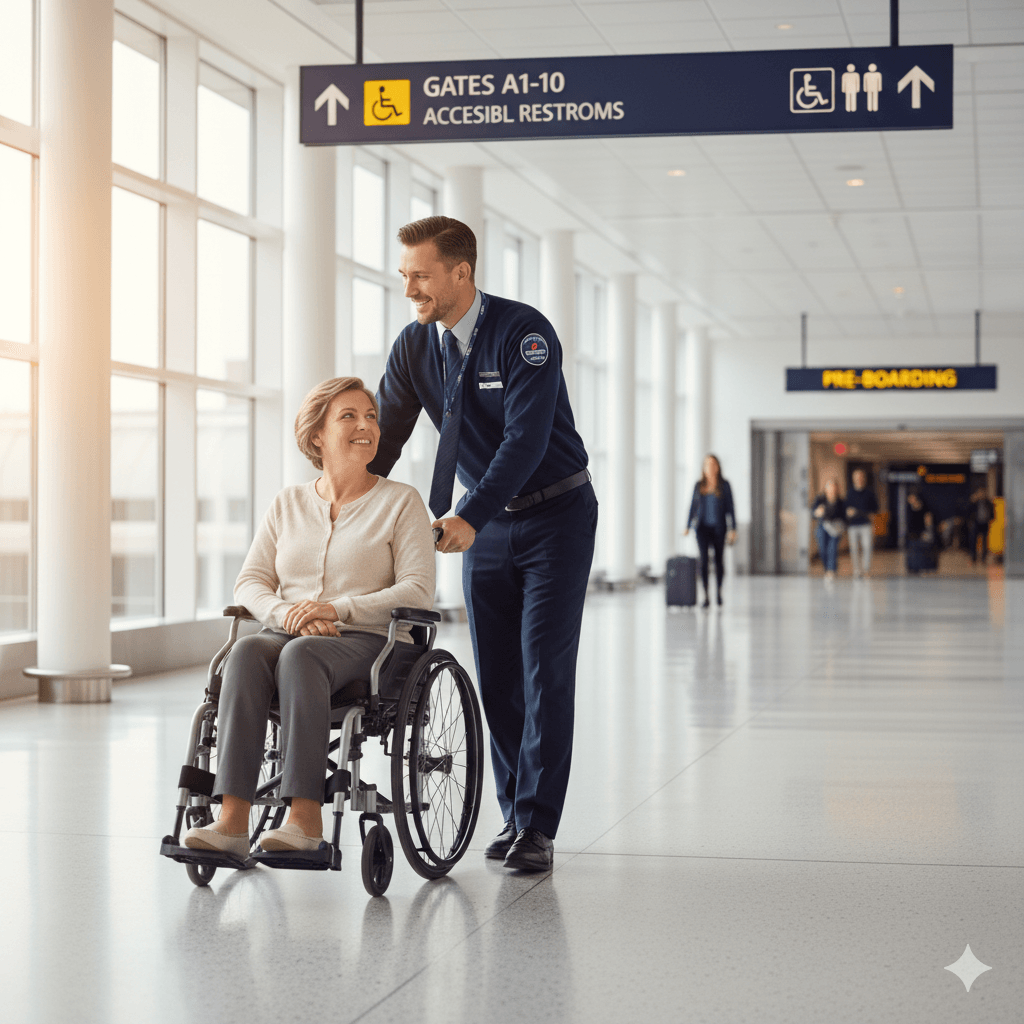 A Seamless And Dignified Journey
Atlanta Hartsfield-Jackson is enormous, a city in itself. Rolling across Terminal T , I realized that airports are microcosms of accessibility challenges : long distances, crowded security lines, and inconsistent staff training. The airport's official website promised "ADA-compliant pathways," but in practice, the devil was in the details.
The real test wasn't just moving from point A to B—it was anticipating friction points, choosing adaptive gear wisely, and learning how to advocate for myself . That week became a crash course in navigating accessible airport services.
Why Airport Accessibility Matters
Airports are the starting point of every journey , yet for travelers with mobility needs, they can be the biggest barrier. Beyond ramps and elevators, accessibility involves:
- Wheelchair and mobility device support
- Trained assistance personnel
- Seamless check-in and boarding procedures
- Accessible restrooms, lounges, and seating areas
Without these elements working together, travel can feel disempowering and exhausting . Conversely, airports that invest in comprehensive accessible services turn a logistical challenge into a smooth, confidence-boosting experience ( ADA.gov: Airport Accessibility ).
Planning Ahead: Questions to Ask Before You Fly
Preparation is key. Over the years, I've learned that every airport, airline, and trip is unique . My pre-flight checklist has grown into a ritual:
- Wheelchair Assistance: Confirm if the airline will provide a wheelchair from check-in to the gate and from gate to baggage claim. Delta, for example, offers wheelchair types including collapsible travel chairs or power-assist models. I always request gate-to-gate service if my flight involves transfers.
- Boarding Procedures: Airlines have different rules for pre-boarding. Some offer early boarding only , others allow priority boarding for any mobility need .
- Airport Layouts: Check terminal maps for accessible routes . Atlanta's Terminal T has elevators every 120 meters , but escalator-only sections exist near security, requiring detours.
- Bathroom Access: Locate ADA-compliant restrooms near gates and waiting areas. Many older terminals have inadequate space for transfer lifts.
- Security Screening: TSA rules permit wheelchairs to stay occupied while being scanned; motorized chairs must have battery terminals disconnected . Always check the latest guidance ( TSA: Traveling with Disabilities ).
I send these questions via email to both the airline and airport assistance desk, requesting confirmation with staff names if possible . Written clarity prevents last-minute surprises.
Navigating the Airport: A Step-by-Step Experience
Rolling through an airport requires a combination of physical navigation, timing, and human coordination .
Check-In and Bag Drop
At Delta counter 24 , I unfolded my wheelchair while Roux waited by my side. The clerk smiled but admitted, "Our powered lift chairs are on standby—may I show you where?" Within minutes, a trained mobility assistant arrived with a TravelMate 3000 folding wheelchair, measured at 32 inches wide , just enough to glide through the check-in line.
A lesson here: never assume a "wheelchair-accessible" desk means the staff can accommodate your chair . Always confirm dimensions, lift availability, and ramp access.
Security Screening
Security remains one of the most stressful points. I learned early that timing and patience are everything :
- Motorized chairs must be removed or scanned with batteries disconnected.
- TSA personnel vary in familiarity with transfer lifts and seated screening .
- Personal items like portable oxygen tanks or battery packs require additional documentation.
At Atlanta, a security officer trained in ADA procedures guided me through the metal detector while keeping my wheelchair and cane in reach—a small gesture that drastically reduced stress.
Boarding and Gate Areas
Airlines provide pre-boarding for travelers requiring assistance. I always position myself near the boarding ramp , ensuring the aisle and lift are free of luggage clutter.
A personal anecdote: during a Miami flight, my assigned aisle seat, 18B , was narrow for my travel wheelchair. The flight crew swapped me to 19A , adjacent to the bulkhead, giving 48 inches of clearance for a smooth transfer. Such flexibility is rare but invaluable.
Adaptive Gear and Mobility Devices
Traveling efficiently requires the right tools. Over the years, I've relied on:
- Collapsible travel wheelchairs: lightweight, easy to fold, perfect for gate-to-gate service.
- Portable transfer boards and cushions: help bridge the gap between wheelchair and airplane seat.
- Battery pack covers: TSA-approved, preventing sparks during X-ray scanning.
- Service dog gear: harnesses, portable water bowls, and leashes clipped to carry-ons.
One memorable day, a battery-powered Pride Jazzy Air failed mid-terminal. The airport assistance team had a manual wheelchair ready in under five minutes , showing how backup equipment is critical for stress-free travel .
Case Study: Chicago O'Hare
During a winter 2022 trip, I navigated O'Hare's Terminal 5 , notorious for long distances and construction.
- Wheelchair Assistance: Requested gate-to-gate service , including shuttle across concourses.
- Bathroom Access: Some restrooms had doors opening inward only; staff had to assist me using a folding transfer lift .
- Security Delays: Peak winter travel meant longer waits; pre-boarding and airport-provided courtesy seating helped.
Traveler quote: "I didn't realize how exhausting airports could be until I had to wait two hours for a transfer lift. Planning ahead and communicating with staff made the difference."
Airlines and Their Accessibility Programs
Airline accessibility varies widely. Some highlights from my experiences:
- Delta Airlines: Offers pre-boarding, in-flight wheelchair storage, and aisle transfer chairs ( Delta Accessibility ).
- United Airlines: Provides wheelchair assistance at hub airports and advanced notification for special devices ( United Accessibility ).
- American Airlines: Supports power chair stowage and offers detailed mobility equipment guidelines ( American Accessibility ).
Pro tip: call ahead to reconfirm assistance , even after online booking. Staff changes, terminal layouts, and equipment availability fluctuate daily.
Mini Case Study: Atlanta to Tampa
In summer 2023, I booked a Delta flight with gate-to-gate wheelchair assistance .
- Pre-flight: Staff provided a folding TravelChair Pro from check-in to gate.
- Boarding: Pre-boarding allowed a bulkhead seat transfer , with aisle chair provided.
- Arrival: Tampa airport assistance transported me directly to the accessible rental car area , with ramps cleared and staff helping unload my foldable power chair.
The small details— extra time allocated for boarding, advance notice of lift dimensions, and staff coordination —turned a potentially stressful journey into a smooth, empowering experience.
Common Pitfalls and Lessons Learned
- Assuming Airports Are Uniform: Older terminals may lack ramps or adequate elevator width. Always verify maps and photos.
- Equipment Compatibility: Not every aisle chair fits every seat or doorway. Bring your own or request specifications.
- Staff Training Variance: Some personnel are unfamiliar with ADA guidelines. Written confirmation helps mitigate misunderstandings.
- Battery Transport Rules: Always check airline and TSA updates on lithium-ion batteries .
- Timing and Scheduling: Peak travel times increase delays; arrive early, ideally three hours for domestic, four for international flights .
Beyond Assistance: Lounges, Seating, and Comfort
Airport accessibility extends to restrooms, lounges, and waiting areas . Some personal insights:
- Accessible Lounges: Delta Sky Club at Atlanta T4 provided spacious restrooms, ramps, and adjustable-height seating .
- Charging Stations: Critical for powered wheelchairs; not all terminals provide outlets near ADA seating.
- Quiet Zones: Long waits are taxing; I seek quieter gates or unused boarding areas to stretch, hydrate, and recharge .
Traveler quote: "I underestimated the need for quiet, spacious seating until my layover in Denver. A simple bench in a less crowded area made all the difference."
Planning Your Airport Trip: Practical Checklist
- Confirm wheelchair assistance and route from curb to gate.
- Verify restroom and lounge accessibility at all connecting airports.
- Bring portable transfer aids for boarding and seating transitions.
- Check battery rules for scooters and power chairs.
- Request seat changes in advance to maximize clearance.
- Email confirmations to staff and keep screenshots.
- Have backup manual chair if motorized devices fail.
- Coordinate with service dog accommodations if needed.
- Allow extra time for security and connections.
Reflection: Traveling Confidently
Accessible airport services are about more than compliance ; they're about empowerment, independence, and dignity . Each trip I've taken has reinforced a simple lesson: preparation plus advocacy equals freedom .
From Atlanta to Tampa, Chicago to Miami, I've learned that the small details—ramp widths, transfer boards, staff coordination—define whether travel is stressful or exhilarating . A few thoughtful questions, a bit of patience, and the right adaptive gear make airports feel less like obstacles and more like gateways.
About Harper Shore
Harper Shore has spent over a decade traveling the globe with wheelchair travel accessories, mobility aids, and service dogs , navigating everything from major international airports to small regional terminals. Her guides blend expert accessibility knowledge with personal storytelling , offering readers a trusted roadmap for confident travel.